Saturday, 17 May 2008

Saturday, 3 May 2008

Fine Art Statement 2008

Industrial machinery has an obvious mechanical function that can overshadow their machine aesthetic. The mill machines flaunt a functional, yet artistic production, revealing the design to be based on more than mathematical and scientific principles, taking on architectural considerations of space, volume, texture, materials, light and so forth. However I do not present my work as a mechanical form to represent the machine’s functional or intrinsic meaning and the work shies away from any social commentary on the industrial decline, particularly in the North. Furthermore it is not an addition to the critique on modern optimism in technological progress. The found objects and clay-work serves to address and contemplate the increasing variety of non-traditional forms found within today’s art world.

The clay-work has been primitively built and is devoid of any utilitarian purpose. Consequently performing an Aristotelian function, as the art audience is cathartically released from the pressures of an increasingly sophisticated and technological age. This psychological value is created through the work’s denunciation of technology and rejection of contemporary provocative art themes. The work’s ephemeral and unfinished quality, created through the use of unfired mud clay, wood and obsolete mill parts, creates an essential humanist quality that demystifies the artwork and helps incorporate the piece into an understandable and immediate language.

The cracks that appear after the clay has dried ruminates Duchamp’s belief in the importance of the ‘role of the accident’ in an artwork’s creation. Whilst the medium’s ductile pliability also acknowledges the artist’s personal style, their patte (‘paw’), which references traditional notions of authenticity and originality. However the work’s obvious compositional association to industrial machinery somewhat abstractly attaches the work’s ‘aura’ to the idea of reproducible forms.

The location of the exhibition in Armley Mills furthered the work, as I then wanted to create a completely disparate mechanical idiom, an ‘a-mechanical’ sculpture. The abandonment of the factory parts for clay and the final decision to not paint a black matte finish gives the installation of these artworks within an old industrial environment even more impact. The anti-functional aesthetic of the work emphasises the appropriation of the wheel, handle and cog forms. The strong symbolism between the work and the mechanical machines outside the gallery space almost allow the clay to have a sense of movement and to seemingly possess a mechanical function.

Thursday, 17 April 2008

Sunday, 6 April 2008

InDesign Course

InDesign Course, 31st March-4th April

Over the Easter holidays I took an InDesign course at the London College of Communication, as I have volunteered to create and design my exhibition group's catalogue. We are getting a special discount from the printing company because Catherine dates the boss' son but that is the limit of the help. This is the information for the layout:

Size- 148.5 x 105 mm. (A6) Portrait. Use Indesign if possible (though said if problem can use another) All images cmyk, 300 DPI (300 DPI- he said if possible- nearest) Colours- all spot colours to convert to cmyk Font- all font converted to outlines (so like an image not text). CS2 not CS3 version of indesign 3mm bleed is fine.

Notes from the course:
- White arrow highlights the content
- Black arrow highlights the box
- To make text flow- shift then click
- Text formatting: to change the layout of the master copy -> Layout -> Layout Adjustments -> Enable Margins and Columns (this skill is useful for 'boring' designs)
- Grid- makes boxes though the user has to make the text flow
- Select all= Apple key and A
- Colour and stroke icons
- Wrap around bounding box- makes the text jump, opp. is text wrap
- Object -> Text Frame Options -> Adjust text layout in a box- space between the border of the box for text inside
- To personalise bullets -> Glyphs and Tabs

... Notes follow in Sketchbook 2

Monday, 17 March 2008

Idea: Felt Making

I could use all the wool collected to make felt. Then perhaps I could print some images onto the material... I supervised a Felt Making Class at the gallery I used to work for, Dulwich Picture Gallery, and it was relatively straightforward.

A step by step to felt making felt

You will need a flat surface to work on, where it doesn't matter if it gets wet. (outside, floor, counter-top or large table) Place a large table onto the flat surface, and cover it with a piece of plastic.
Pull the clean wool into short sections.
Place these wool pieces evenly across the plastic. Lay them all in one direction,(vertically) overlapping each piece slightly, until you have a square about 35cm long. Repeat horizontally.
Repeat the layers of wool again. Make sure each layer alternates in direction, vertically/horizontally.
The top layer can be decretive, using different coloured wools.
Fold the remaining length of plastic over the wool.
Place the into the bathtub and roll the mat back and forth, working your hands evenly across the mat.
Keep the mat rolling in the hot water for x-about 3 - 4 minutes. It is friction that causes the wool to felt.
Remove the mat from the bathtub and place it on the towel. Carefully unroll the mat, and turn the felt 1/4 turn. The felt is quite fragile at this point, so be gentle.
Reroll the mat and put it back into the bathtub. If the water has cooled, drain the tub and add more hot water. Roll the mat again for x-about 3 - 4 minutes.
Turn the felt another 3 times, and reroll for x-about 5 minutes between each turn.
Test the felt by rubbing it with your finger. The fibres shouldn't move and the felt should be quite thick. If it is still soft, turn it again and keep rolling it in the hot water.
Remove the felt from the beach mat and rinse in cool water.
Roll the felt in a towel, place it on the floor and stomp on it, to remove the excess water. Lay flat to dry.

Saturday, 15 March 2008

Photos of Bradford Industrial Mill's Storage Area

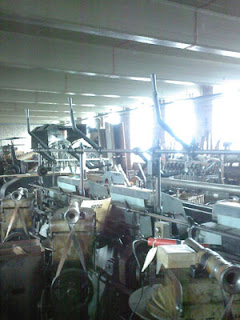
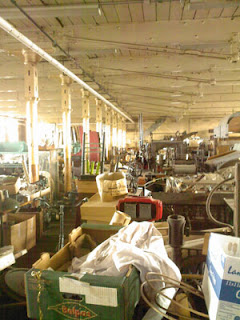
Following several emails and follow-ups with a councillor from Bradford, I managed to get hold of various industrial parts that were surplus, broken or unwanted. When I went to collect the pieces I was lead into this treasure trove of machine parts. It was so surreal to be walking through a narrow path created in the midst of these heavy-duty machines and piles of industrial parts.

Friday, 14 March 2008

Research Notes on Jean Tinguely

Jean Tinguely at the Tate Gallery
8th September – 28th November 1982
Alan Bowness and Richard Calvocoressi

- Neo-Dadaist who rejoices in paradox and ambiguity
- Kinetic artist who mocks the kinetic sculptures that place faith in new materials and up-to-date technology
- Belief that the only certain, stable thing in the world is movement, perpetual motion, change
- Interest in the immaterial/ breaking down the traditional stability of the work of art/ dematerialising static image or form into a continuous flow of movement and sound
- Sculptural works: scrap iron, old or obsolete mechanical parts, discarded household products, various familiar objects
- Often primitively built- unpredictable in action and devoid of a utilitarian purpose
- Some sculptures have digested and disgorged footballs, sprayed water, crushed bottles, smashed plates, painted abstract pictures, emitted agreeable or threatening noises, emanated smells or even destroyed themselves
- Real function of his work is irony- a parody of mechanical and human behaviour, a satire on production, consumption and waste
- His work performs an important psychological service by offering a release from the pressures of an increasingly sophisticated tenchonological age
- The object at rest in transformed into the mobile, the living work of art, by switching on an electric current
- Requires the viewer to participate- press the switch- establishing a relationship with the machine
- Terms his work, ‘meta-mechanical’- describes the irrational, imaginative, a-mechanical ends to which his machines are put
- Socially liberating aspect of this new contract between artist, machine and spectator
- Early machine work was based on a system of asynchronous gears that moved the various parts- bars, circles, rectangles- each part moved at a different speed, so it could be months or even years before the same configuration repeated itself
- Shifting relationships and infinite variations of chance in action- alluded to the fragmentary sensations and conflicting rhythms of modern life
- Tinguely’s interest in the potential of a rotating or spinning motion to challenge and alter formal appearance is central to his work
- His early work relied for its optical or kinetic effect on the spectator as motor rather than on built-in mechanical movement
- His work is indebted to Duchamp’s- his first open-wire constructions, which were operated by handles, recalls Duchamp’s preoccupation with the wheel and mechanical rotation
- His ‘Prayer Mills’ also bears a slight resemblance to Duchamp’s tiny but influential painting ‘Coffee Mill’ of 1912
- Duchamp’s optical machines, such as ‘Rotary Demisphere’, 1925, also caused Tinguely to research illusion and dematerialisation
- Also was intrigued by Duchamp’s questioning, ironical attitude to the value of art in the age of technology and mass communication
- Heavily influenced by Duchamp’s elevation of the role of accident in artistic creation and his almost existential belief in the significance of gesture.
- Felt art should have a direct contact with urban and industrial culture, its by-products and side effects: mass production, waste, advertising, violence
- By reintroducing reality into art, the intervention of the artist would often by reduced to a minimum
- Demystify art- simple, immediate language
- Tinguely disliked the schematic and finished look of Abstract Expressionist work- symbolised a misguided wish to immobilise time- by using unfired clay my work also lacks a finished, immortal quality
- Searched for an ideal environmental art, a fusion of sensory and motor experience within a unifying structure, in which spectator involvement assumes a crucial place
- Expendable or auto-destructive works of 1960-62- when large and often intricately assembled collections of disused machinery and scrap sprang into action and, after a frantic life of half an hour or so, exploded or set fire to themselves- almost nihilistic
- Reflected the Happenings- introduced movement and change, engaged most or all of the senses and demanded active cooperation, whether physical, emotional or intellectual
- Belief that scenes of violence or destruction would have a positive, therapeutic benefit for the spectator
- Mounting anxiety about the threat of nuclear warfare/ significant advances in computer technology as well as attempts at manned space travel
- Auto-destructive- a work of art which is ephemeral and which therefore has little or no commercial value
- Impressed by the junk sculptures of Richard Stankiewicz
- Stated that his work became more disgusting, when the museums became whiter
- Late 1960s- began to openly display the belts, pulleys and wheels which assisted the moving elements in his work
- Shone bright spotlights on his machines, throwing strong linear shadows onto the walls and creating a strange, spectral impression
- Had a romantic fascination for mean, worthless materials
- Deliberately used cheap, worn-out motors and gears which added to the chance effect- exploited the machine- demonstrated properties not usually associated with it, such as random movement, irregularity, disorder
- Almost nostalgic art- disregarded electronics and advanced technology
- Sculptures often moved erratically, often shaking themselves into paroxysms of cacophonous activity- air of improvisation
- After 1963, Tinguely began to paint his sculptural works a uniform matt black- depriving them of their character as an assemblage of recognisable objects rescued from the rubbish tips and attics of urban life- emphasised their formal, plastic qualities
- Matt black- work began to resemble pieces of nineteenth century industrial machinery
- Allowed the grotesque- a groaning/ grinding/ clanking progress- endlessly frustrated in the intent- metaphor for imprisonment as the work is weighed down by lengths of heavy chains which it is forced to carry
- Changed the speed of rotation so all sorts of visual and sonic patterns would emerge
- Early 70s, the work became more colossal, heavyweight and industrial
- Essential underlying humanism of his work, the range of emotions and sensations it embraces, from soft to loud, gentle to brutal, restrained to exuberant, reassuring to disturbing

Monday, 10 March 2008

Visit to Bradford to see the Mill Machines at Work

CFA Contemporary Fine Arts

'Die Wahren Orte' Exhibition (No.1 exhibition in the Berlin Biennale!)

Alexander Ochs curated this exhibition based on the idea of 'true places' and whether they should be discussed in the past or present tense. As can 'true places exist in a world of constant flux under a globalised market'? It is interesting to note that Ochs spends half his year in Berlin and the other half in Beijing, so he must do a lot of wandering between these two very different worlds. I found this exhibition quite exciting as all of the eight artists seemed to be dealing with existence and superficiality in their own individual quest for a 'true place', whether in culture, art, time, location etc., though the resulting work was incredibly varied.

I really liked Yang Maoyuan's response as he had created a line-up of Buddha heads, which were reminiscent of the heads of the Buddha-figures that are everywhere in Asia. Therefore the series seemed to comment on the use of serial technical fabrication, thought the mock-antique patina and a fragmented condition alluded to actual archaeological finds. By weathering the marble to such an extent, the sculptures were also deprived of any trace of individuality, which made the act of falsifying an imitation even more prominent.

However my favourite piece was a room length installation by Yin Xiuzhen. The piece, 'Collective Unconscious', not only had a strong visual presence but it also had an audible quality, as she had a Chinese pop-song, which apparently praised the city of Berlin, playing within the vehicle. The artist had utilised a mini-van, an old Chinese 'shared taxi', which she had cut into halves. The 'shared taxi' was used in the 80s and 90s, as an affordable means of transportation within the rapidly growing metropolis. However due to its cheap design and bad quality, the Chinese government withdrew it from circulation during the 90s. Therefore by extending the vehicle, using a long, rhythmical caterpillar like insertion made of clothes, the vehicle looses any pretence of stability and sturdiness. What I really enjoyed about this piece was how the viewer was allowed to climb into the work and sit on any of the multitude of seats inside. The clothes were also used to hint at the low cost but bad quality produce of China.


Andy, James and myself in the back of the mini van

Saturday, 8 March 2008

Trip to Berlin, March 3rd-7th

We stayed in Mitte, very close to Alexandra Place, near Rosa Luxemborg station. During the three days, we went to a ridiculous number of museums and art galleries, averaging around four or five. I have a pile of phamplets, exhibition magazines, sheets of info etc. James has brought a folder for all the collected memorabilia but to be honest mine will probably be left to gather dust on my book shelf, so I thought it was best to write a few reviews of my favourite pieces/ exhibitions, so some evidence will exist!

We went to the 'Alte Nationalgalerie' (the National Gallery). It was astonishingly similar to our National Gallery in the decor and layout. I enjoyed the French Impressionists work on Level 2 and the Realism on Level 1. I was also impressed with the Neo-Baroque sculpture and the Auguste Rodin sculpture 'The Age of Bronze', 1875-76. Apart from that, I can not recall anything else worthy of note but I am sure hundreds would disagree!

We also visited the Institute for Contemporary Art, which was exhibiting '...5 Minutes Later', curated by Susanne Pfeffer. The work is this exhibition varied considerably in my opinion. In the large entrance area, the furthest wall simply read; 'VISITORS CAN CONTEMPLATE FOR 5 MINUTES THE INVISIBLE ASPECTS OF THE VISUAL ART IN THE EXHIBITION'. This immediately made me doubtful... It wasn't until I reached the third floor and began watching the video installations that I thought the exhibition had been worth the trek. With particular reference to Lutz Mommartz's video art pieces, 'As if it was from Beckett', 1975, and 'Way to the Neighbour', 1968.

'Way to the Neighbour', Lutz Mommartz, 1968.
http://www.youtube.com/watch?v=JaCkR0q_TVE

Various Holiday Snaps:


Sunday, 2 March 2008

Armley Exhibition Proposal


Sarah Baumann

Materials: Clay, resin, varnished wood, polyester, found objects

My art practice focuses on mechanical and industrial forms drawing inspiration from outside a traditional fine art context. By expressing the hand of the artist and eliminating mechanical geometry, the sculptural work is drawn into speculations about authenticity and reproducibility. Therefore the work is thrown into the language of craftsmanship and art though not entirely disrupting its potential for being recognised as a mechanical expression.

Piece 1:
I plan to create a relatively large sculptural piece, with a base of 120cm x 45cm, which will combine clay elements alongside abandoned and disused mill machine parts. The clay will serve to minimalise the mechanical-technological nature of the work by making the viewer closely observe the handcrafted machine parts. The assemblage will also emphasise the spatial relationships between various parts in the piece, hinting at the relationship between the actual gallery setting and the artwork. Consequently allowing the viewer to question and consider the tripartite division of science, craft and art.

Piece 2:
90cm x 90cm.

A formal sculptural work with three iron- oxide resin casts of rollers used in a make-shift conveyor belt system. The belt, created with stretch polyester fabric, has industrial images printed on the fabric so to create a more literal link to the initial inspiration.

Tuesday, 26 February 2008

Marcel Duchamp and Max Ernest: The Bride Shared

Notes from 'Marcel Duchamp and Max Ernest: The Bride Shared', David Hopkins
(London: Clarendon Press, 1998)
Marcel Duchamp, 'Etant donnés', 1946-66.
Language was ambiguous – ‘technical problems’
Cite ‘technical matters’ as the genesis of his work, not ideas
The ‘sliding scale’ of meanings along the vocational line of artist-artisan-engineer
Industrial aesthetics debate in German- early 1910s.
‘Looking’ in the aesthetic sense, then, meant looking with assistance from literary associations, looking for purely visual pleasure. The addition of ‘the book’, words, text and the process of consulting took the artwork even farther from the beaux-arts realm of the merely ‘retinal’ which Duchamp was in the midst of abandoning

Modern debate concerning the overlapping functions of artist, craftsman and engineer
Conception of his great ‘work’ with its many ‘new technical problems’

In French there is an old expression, la patte, meaning the artist’s touch, his personal style, his ‘paw’.- Calvin Tomkins, ‘The Bride and the Bachelors: Five Masters of the Avant Garde (NY: Penguin Books, 1976) pp. 24
Duchamp equated the artist’s ‘hand’ with the sensual appeal of richly applied paint; and that, in turn, was related to the animal side of human nature and opposed to the artist’s intellectual capacities

Not sought out the mechanical or industrial forms for their intrinsic (i.e. functional) meaning, nor as social commentary on industrialisation, but, rather, for their ruptual value as non-traditional forms within a fine arts context
Incorporated the mechanical into the anthropomorphic for precisely that disruptive (i.e., avant-garde purpose)

Demonstrate the ‘free hand’ or the ‘paw’ of the painter, which Duchamp so abhorred, and the mechanical aspects did not suffice to cover it up- the ‘visceral’ aspect of the bride
Continue to inset machine into flesh at the level of pictorial narrative- ‘mechanically’ painted
‘very precise technique’ of mechanical drawing as ‘a renunciation of all aesthetics’

Art is an outlet towards regions which are not ruled by time and space
Mechanical drawing […- up[held] no taste, since it is outside all pictorial convention
Expressed ‘the most sublime notions of artists- a means of communication and a practical instrument used by the worker-artist and the artisan
Drawing that limited the appearance of things to the naked eye and drawing that revealed the truth of things behind the surfaces of appearance; that is to say, there was perspective drawing and mechanical drawing. Each kept a relation to the object.
The blueprint for production, the working drawing for the commodity. The language base was hardly neutral; it cheerfully ratified the means and ends of industrial production

Striving towards accuracy and precision, no more handwork
Distinct from the mechanical idiom preferred by the avant-garde- new method of mechanical expression
Back to a completely dry drawing, a dry conception of art
The prioritisation of function over appearance- a preference for the language of industry, work and craftsmanship to that of the fine arts
Thus new ‘works’ appeared- all involved with ideas of craftsmanship, new materials, new techniques, new art forms
Moved farther along the line from art to craft
Sewing thread was stitched onto the canvas and a leather label printed with gold letters- ‘Broyeuse de chocolate, 1914’ was glued to the surface
Additions and the matte finish of the paint coupled with the simple design to suggest an object of hand-crafted leather which has somehow been flattened onto the two-dimensional picture place

Several kinds of artisanal endeavours are referenced, particularly those that incorporate sewing and leather working, for example, shoe-making, upholstering and bookbinding.
Sewing thread, paint, canvas, leather labels and gold letters
Chance and measurement became the tools with which the fine artist/craftsman proposed to repair the flawed system of high art
‘cast […] a pataphysical doubt on the concept of a straight line as being the shortest route from one point to another’
Measurement of the boundaries of ‘art’ had as its standard a curved ‘ruler’; one metre was changed from a straight line to a curved line without losing its identity
Alter the fundamental geometry of its definition without entirely disrupting its potential for being recognised as art
Simultaneously were and were not fine art
Materials which had been associated with a modern, industrial aesthetic since the middle of the nineteenth century

Time element- eight years- devoting an extended period to the execution of a work of art, was another technique for shifting the focus away from fine arts towards craft
Large Glass- incorporated most of the handicraft techniques
Painstakingly handcrafted nature and the length of time- on its conception and construction
After Duchamp ‘incompleted’ it

Psychology of the relationships between the viewer, object and environment was paralleled in Duchamp’s interest in exhibition design, window display and the complex viewer/object/environment relationships of Etant Donnes

Frederick Kiesler, ‘Contemporary art applied to the store and its display’ (NY: Bretano’s, 1930) pp. 67-8.- ‘He concerns himself no longer, as did the potter, the goldsmith, the weaver, with the materialisation of his drawing; the machine has freed him from this task and does it more exactly, quickly, cheaply, and as beautifully
-union is far from subversive- Kiesler envisions the artist/ craftsman happily benefiting from machine production
Its technique, its materiality and structural foundation

‘Incompleted’ the Large Glass work- stage set for Capek’s R.U.R, produced in Berlin in 1923- designed a huge montage, compiled from the most diverse apparatuses and machine parts (megaphone, seismograph, tanager device, iris diaphragm, light bulb)- some real, some painted.- could produce light and sound as well as project film and create optical illusions with mirrors

Presented technology as a threat culminating in the ultimately sinister discovery of robots
Representation of the mechanical world was full of admiration for a technology that functioned with precision, fully in agreement with the technical aesthetic subscribed to by almost all avant-garde artists of the twenties

Negative look at the industrial age, particularly at that intersection of the mechanical and the human
Duchamp’s Bride and her Bachelors are gasoline-driven, fully-lubricated, piston-fired motors, but they also are erotically charged, love-torn, questing beings- desires are eternally unfulfilled, that all their sparks and gases and rods and cylinders never ignite a roaring engine is one of the most effective statements of an anti-Positivist, anti-functionalist, anti-machine aesthetic ever conceived.
The anthromorphic and the mechanical merge in ways that hardly provide pictorial reassurance about the future of an industrialised society
Smoothly painted, hard surfaces and tightly-coiled springs suggest mechanical models- shapes and predominantly biomorphic and the allusions noticeable sexual
Unquestioningly the assignment of positive cultural values to mechanical forms and processes
Shun of optimistic faith in modern technological progress […] and their belief that through their purified language they were offering a kind of blueprint for the designed utopia of the future
Primitivist myth (freedom, spontaneity, instinctiveness and ritualistic fantasy) and a sense of responsibility to its own time
Elderfield- Duchamp’s machine work exemplified ‘clothing primitivist obsessions in modern dress’
Centuries-old handicrafts as well as the most modern machine technologies
Relevance for commerce and industry
Not its determination to fuse art and industry- makes the gap more stark

Denunciation of many of the techniques, materials and themes ordinarily associated with ‘fine’ arts constituted an outrageous and powerful gesture of defiance
If Duchamp had wanted to put art ‘once again at the service of the mind’ he also wanted to ‘discredit science’
Deny the value of industrial progress than to depict pure sexuality and passion in mechanical forms that are not capable of consummating their desires
Deconstruction of the modernist myth of the artist as specialist through the enactment of the role of bricoleur


Duchamp forced to admit that he had been an artist all along, felt obliged to paint and sculpt it ‘back into the world’- and into art.
Symbolism persists but in a sense the movement has been from the world of veiled allusions and ‘imaginary solutions’ to a realm that relates, albeit at several removes, to the world of Surrealism
Retains its mystery, perhaps because the symbolism is so blatant that in a sense it cancels itself out

Vestigial yet obsessive presence, half phallus, half machine.
Obviously abstracted and symbolised to a high degree

The bride has been brought down to earth with a band, but the Bachelors have been reduced or compressed into a gas lamp, now truly fired with the bridal gas, symbol of desire and tumescent excitement. The liquid, the water, appears to have symbolic attributes that are both male and female; the pond is deep and still, the waterfall restless and incessantly active in its downward thrust- intense physicality

The strong linear element which results in a greater fluidity of form, the feeling of transparency and the austerity of the colour harmonies in what is basically a range of earth colours, browns and sienas

Saturday, 23 February 2008

Art in Context: Marcel Duchamp


'Art in Context: - The Bride Stripped Bare by Her Bachelors, Even and Etant Donnes'
John Golding (London: Penguin Press, 1973)


Duchamp carefully created The Bride Stripped Bare by Her Bachelors, Even, working on the piece from 1915 to 1923. He executed the work on two panes of glass with materials such as lead foil, fuse wire, and dust. It combines chance procedures, plotted perspective studies, and laborious craftsmanship.

Does not flaunt its mechanical-technological nature
Large Glass revealed its mechanical associations, Etant Donnes conceals its own- ever ‘an orchid in the land of technology’

Close connection with the materials and processes normally associated with handicrafts
Observe painstaking and minute adjustments in Duchamp’s production of his last piece- as demonstrated in the Approximation Demontable.
There is also the manual, handmade quality of Etant Donnes- executed every step of the construction, placed every nut and bolt, brick and piece of wood

Emphasis on spatial relationships within the assemblage also suggests a continuation of Duchamp’s interest in (quasi-) scientific investigations of the fourth dimension
Art, machine, craft, science- Etant Donnes is all four, ironically incorporation their differences as well as their similarities, hinting provocatively at historical relationships while flaunting its own uniqueness within Duchamp’s oeuvre and the history of art, raising endless speculations about authenticity vs. reproducibility and the artist as specialist vs. the artist as bricoleur.
The questioning of traditional values associated with the artist’s ‘hand’, i.e. notions of authenticity and originality, seems to be reversed by Etant Donnes.
Apparent non-reproducibility, its observance of the established forms of originality and ritual constitute what Walter Benjamin called the ‘aura’ of the authentic work of art.
Utilised a compositional technique with strong mechanical and geometrical associations, which he termed ‘elementary parallelism’ and described as ‘linear elements following each other like parallels and distorting the object’.
Newfound interest in the mechanical, attached even more intimately to human aspects
An element of conflict
Earlier works had represented single figures or figures clearly not in conflict

Bride and her Bachelors in a drawing entitled, La Mariee mis a nu par ces celebrataires’- clearly three entities and the threat of conflict is unmistakeable; the Bride stands in the centre menaced by a Bachelor on each side armed with sharp, knife-like weapons.
Hostility he felt towards the artists he had trusted to understand and value his aesthetic risk-taking
Verbal images of abandonment, exhaustion and divorce
Duchamp was not just abandoning his association with Cubism but painting itself
Large-size work- all sorts of new technical problems to be worked out
Notions of ‘occupation’ and ‘technical problems’ were clearly associated- shifting his orientation from that of artist toward that of craftsman.

Tripartite division of sciences, arts and crafts dating back to the sixteenth century
Toward a particularly non-French construction of the artisanal function- pose as a bricoleur rather than a specialist

Deliberate reorientation of his work from painting to craft
Enormous industrial expositions- artistic milieu in Germany was divided by the artisan/engineer question

The collective e semantics that functionalism found in the immanent aesthetics of the machine. Artisans became intellectualised, and for them this was a social elevation: they became conceivers more than makes, equals of engineers more than of workers. But this elevation took place to the detriment of the ‘human’ and individualist values that had been part of their production before division of labour had set in. In moving closer to the engineer, the artisan moved away from the artist. [….] In moving away from the artist the artist at the level of making, of craftsmanship, the artisan moved closer to the artist at the level of creation, of authorship’ –Pictorial Nominalism, pg. 56, de Duve

Marcel Duchamp: Etant Donnes and The Bride Stripped Bare by Her Bachelors, Even

Notes from 'Art in Context', edited by John Fleming and Hugh Honour

The Bride Stripped Bare by Her Bachelors, Even

Duchamp carefully created The Bride Stripped Bare by Her Bachelors, Even, working on the piece from 1915 to 1923. He executed the work on two panes of glass with materials such as lead foil, fuse wire, and dust. It combines chance procedures, plotted perspective studies, and laborious craftsmanship.
Does not flaunt its mechanical-technological nature
Large Glass revealed its mechanical associations, Etant Donnes conceals its own- ever ‘an orchid in the land of technology’

Close connection with the materials and processes normally associated with handicrafts
Observe painstaking and minute adjustments in Duchamp’s production of his last piece- as demonstrated in the Approximation Demontable.
There is also the manual, handmade quality of Etant Donnes- executed every step of the construction, placed every nut and bolt, brick and piece of wood

Emphasis on spatial relationships within the assemblage also suggests a continuation of Duchamp’s interest in (quasi-) scientific investigations of the fourth dimension
Art, machine, craft, science- Etant Donnes is all four, ironically incorporation their differences as well as their similarities, hinting provocatively at historical relationships while flaunting its own uniqueness within Duchamp’s oeuvre and the history of art, raising endless speculations about authenticity vs. reproducibility and the artist as specialist vs. the artist as bricoleur.
The questioning of traditional values associated with the artist’s ‘hand’, i.e. notions of authenticity and originality, seems to be reversed by Etant Donnes.
Apparent non-reproducibility, its observance of the established forms of originality and ritual constitute what Walter Benjamin called the ‘aura’ of the authentic work of art.
Utilised a compositional technique with strong mechanical and geometrical associations, which he termed ‘elementary parallelism’ and described as ‘linear elements following each other like parallels and distorting the object’.
Newfound interest in the mechanical, attached even more intimately to human aspects
An element of conflict
Earlier works had represented single figures or figures clearly not in conflict

Bride and her Bachelors in a drawing entitled, La Mariee mis a nu par ces celebrataires’- clearly three entities and the threat of conflict is unmistakeable; the Bride stands in the centre menaced by a Bachelor on each side armed with sharp, knife-like weapons.
Hostility he felt towards the artists he had trusted to understand and value his aesthetic risk-taking
Verbal images of abandonment, exhaustion and divorce
Duchamp was not just abandoning his association with Cubism but painting itself
Large-size work- all sorts of new technical problems to be worked out
Notions of ‘occupation’ and ‘technical problems’ were clearly associated- shifting his orientation from that of artist toward that of craftsman.

Tripartite division of sciences, arts and crafts dating back to the sixteenth century
Toward a particularly non-French construction of the artisanal function- pose as a bricoleur rather than a specialist

Deliberate reorientation of his work from painting to craft
Enormous industrial expositions- artistic milieu in Germany was divided by the artisan/engineer question

The collective e semantics that functionalism found in the immanent aesthetics of the machine. Artisans became intellectualised, and for them this was a social elevation: they became conceivers more than makes, equals of engineers more than of workers. But this elevation took place to the detriment of the ‘human’ and individualist values that had been part of their production before division of labour had set in. In moving closer to the engineer, the artisan moved away from the artist. [….] In moving away from the artist the artist at the level of making, of craftsmanship, the artisan moved closer to the artist at the level of creation, of authorship’ –Pictorial Nominalism, pg. 56, de Duve

Friday, 22 February 2008

Notes on Constructivism and Marcel Duchamp

'Critiquing Absolutism: Marcel Duchamp's 'Etant Donnes' and the psychology of Perception' by Linda Louise (Michigan: Yale University, 1995) pp. 1-173.

Overtly sexual theme- did so by resorting to mechanical analogues
The spectators themselves must ‘decipher and interpret’ a work of art, ultimately contributing as much to its meaning as the artist
Manifests a mechanical function as well as an elaborate demonstration of the material and technical skills practiced by many different types of craftsmen and engineers
Electrical systems design and wiring, bricklaying, metalworking and carpentry, as well as more traditional artistic functions such as photography, painting and sculpting and architectural design
Machine aesthetic and craft techniques
Initiated a remarkable strategy to distance himself from the traditional function of ‘fine’ artist, which involved posing ambiguously as artist, craftsman and engineer
Particular set of ideas circulating around the Deutsche Werkbund Movement in Munich 1912
Defy classification as a work of art: is it a painting, sculpture, photography- comprised of characteristic elements of all of these- blur to the point of meaninglessness and add considerably to the viewer’s disorientation and discomfort
Use of scientific and quasi-scientific jargon, concepts and methodology reconciled with his pervasive scepticism
In terms of complexity, size and length of execution
Determination to address the notion of the social construction of gender

In ‘The Work of Art in the Age of Mechanical Reproduction’, Walter Benjamin observed that in the modern era ‘what one is entitled to ask from a work of art’ is ‘an aspect of reality which is free of all equipment’- ‘the sight of immediate reality has become an orchid in the land of technology’[1]
Careful orchestration of spatial relationships and attention to every detail in the design and construction

Motor driven apparatus (motor, circular-metal disc with punched holes, fluorescent lamp cook’s box, frosted Scotch tape, various wooden supports and metal attachments) provides the illusion of a moving waterfall.
An example of mechanical-technological art? It ‘functions’ through the power of electricity. The motor turns the metal disk which creates the waterfall effect, the electric lights contribute enormously to the viewer’s perceptions of space and mass
There is even a ‘switch’ to turn the whole apparatus on and off: namely, the viewer, who activates the electrical power by stepping on the mat outside the door
There are clean analogies with the cinema at work here: the spectator peering through the dark space at a bright illusionary scene, the spectator’s view controlled through a lens (peepholes) and, even the light projected through film to produce the waterfall effect.

Italian Futurists’ devotion to ‘man multiplied by the machine… [a] new mechanical sense, a fusion of instinct with the efficiency of motors and conquered forces’, and, particularly, of Boccioni’s sculpture manifesto, which advised the artist:

‘Refuse to accept the exclusive nature of a single material in the construction of a sculptural whole insist that even twenty different types of materials can be used in a single work of art in order to achieve plastic movement. To mention a few examples: glass, wood, cardboard, iron, cement, hair, leather, cloth, mirrors, electric lights etc.’ Umberta Boccioni, ‘Technical Manifesto of Futurist Sculpture’ (1912), in Appollonio, Futurist Manifestos. Pp. 65

Russian Constructivists’ also raised the issue of the use of mechanical and technological materials and processes for the creation of art. For example, Tatlin wrote, ‘the task… is to find a single form, simultaneously architectonic, plastic, and painterly, which would have the possibility of synthesising the separate forms of these or other technical apparatuses.
[1] Walter Benjamin, ‘The Work of Art in the Age of Mechanical Reproduction’, ‘Illuminations’, trans. Harry Zohn (New York: Schcken Books, 1969), pp. 233-234.

Monday, 18 February 2008

Choice from America: Modern American Ceramics

'Choice from America: Modern American Ceramics' by Arthur C. Danto and Janet Koplos

- C21st ceramics- enlargement or extreme minimisation, multiplying or else reducing- rendering the work banal or sublimating
- Clay- early 1980s- art was battered/ stabbed/ smashed/ distorted
- Craft refers to pre-industrial methods of producing objects of use and of embellishment
- In identifying oneself as a crafts person one implicitly took a stand against the culture of the Machine- declaring an allegiance to earlier and less alienating forms of life
- The hand-loomed, the hand-wrought, the hand-woven, the hand-made, the hand-blown, the home- spun
- Same domestic functions as their mass produced counterparts
- Craft- partly moral and partly aesthetic
- Critically dismissive term, like 'decorative' or 'literary' or 'illustrational'

- In the 'Critique of Judgement', Kant distinguished between free and independent art- the latter 'is ascribed to objects which come under the concept of a particular purpose'
- Dissociates free art from the category of purpose- Kant characterises beauty as 'purposive without any specific purpose'

- Hegel, in his 'Lectures on Aesthetics', claims craftwork can be art but never at its 'highest vocation'- only in its freedom alone can fine art truly be art

- However it is not only art historians that take this narrow-minded view. Richard Serra famously said that 'as soon as art is forced or persuaded to serve alien values, it ceases to serve its own needs'- Therefore claiming that to take away art's uselessness was to make it other than art

- Therefore modern ceramists seem to be attempting to challenge this time-held viewpoint, atleast to a certain extent, by mirroring the movements of modern art. For example when the American Abstract Expressionists began to gesturally handle their paint, ceramists began to leave overt hand marks in their clay.

Friday, 15 February 2008

LoVid

- LoVid are based in NY and started up in 2001
- Their work is semi-narrative- documentary/ electronic music
- Circuit bending- take electronic device and bend wires- touch differents parts of the circuit- make things do something they weren't originally planned for
- Often uses archaic devices- old mixers/ drawing machines- to create experimental video
- New media- not traditional- web-based work/ concepts and themes that relate to technology

- 'Video Wear' 2003- patching different commercial devices- feeding them back and forth onto 14 different LCD screens embedded in protective sports wear to add a seemingly dangerous look to their work
- Breaking signal/ using glitchy signals- static equipment is always breaking down so play on its own nature
- Interested in how electricity if regulated- set of constraints- physical nature of the electrical signal
- Narrative- parralel universe- media is a tangible thing- play on the idea of 'wireless' technology so to create 'wirefull' works
- Not smaller but larger technological equipment- they use a lot of fabric and 100sft wire (working electrical veins)- used in live video feeds
- Dematerialised into a video world- textile, wearable thing- series of photographs- body and electronics interacting
- Collages and drawings- play with organic and technological world
- Body as an extension of technology
- 3D prints are also used as part of the process
- Aggressive vs tender/ Hardware vs software
- Romance and spirituality- they use technology as the metaphor

- 'Experimental TV Centre (2003)- used an old analog video system- continuous yet fragile electronic signal
- A whole room was turned into an instrument
- A patch was connected to the electrical equipment- very reminiscent of video art in the 60s and 70s when one would make their own instruments and not use internal editing
- Analogy- political/ nostalgic
- Also heavily anti- Consumerist- decided to not play with new 'toys' - created personal restrictions and restraints
- Have to enforce very tight manifestos nowadays to make your work seem personal
- The couple commissioned a 3m wide, 1/2m tall table, the length of the room, so to build their own electronic models into it
- Also added suface etchings onto the table's surface around the modular sncyronisers
- Kept 'wirefull' idea by exposing the wires by using clear acrylic around the equipment
- By creating your own electrical equipment- they believed you were able to know the sounds and colours produced by the instruments on a deeper level

Saturday, 9 February 2008

Pavilion Photography Competition


Dear Mr. Duncan,

I would like to submit my work to the editors of Source and to Pavilion for their review, as I would love the opportunity to have my images published. Please see below a description of my work and attached six images.

I look forward to hopefully being able to tell you more about my work on the 23 February.

Yours Sincerely,

Sarah Baumann

'At the core of my practice as a visual artist is an ongoing fascination with the remnants of history, the signs of decay and erosion, and the intricacies of colour and fragility in aged structures, which reveal the process of gradual deterioration. I utilise Leeds’ industrial heritage by appropriating salvaged and reclaimed materials using contemporary, photographic compositions to capture and reinvent the physical traces of the city’s historical past from institutionalised places. This has instigated a sustained engagement with the textural qualities of industrial artifacts, be it the multi-layered fabrics created during the worsted process, or the mechanical surfaces of the machines, or even the subtle renderings of transience on abandoned constructions.

The chosen images are characterised by their ability to harbour a memory of the structure’s transcended usage before being absolved. The multi-sensory experience is greatened by the camera’s subtle explorations of the surface and patina, which detach and abstract the subject from its original context, allowing access to a more metaphorical pictorial language of abandonment, loss, transience or impermanence.'

'The Craft and Art of Clay- A complete potter's handbook'

The Craft and Art of Clay- A Complete Potter's Handbook (London: Calmann and King Limited, 1995)

- Craft means skill- deliberate sense of hand- adds individualism/ show the original softness of the material- textured surfaces
- Engobe- Engobes used on the raw clay and fired on in bisque- firing will be visible in some measure under almost all glazes
- Decorative effects can be obtained by wedging powdered metallic colouring oxides or liquid coloured clays called engobes into plastic clay
- Mid-60s- pottery became the voice of social and political conscience- emergence of the message pot/ uniformity of romantic ideals blunted by a contemporary recognition of artistic multiplicity
- Medium's versatility and challenges- also very accessible
Jerry Rothman, b. 1933 in New York:
- Made Constructivist sculptures till 1961
- Sensual, excessive Postmodern style with the inherent tension of the Classical style
- Penchant for debunking accepted attitudes- typical of his work- embodies him as the ceramic artist as social commentator
- Uses a technique in which pigments surface after firing through the top layer of clay to create shapes of muted colour
- Blurs the distinction between sculpture and vessel

'Sky Pot', 1961, stoneware, unglazed.


'Covered Jar', 1981, Thrown and Constructed Vessel.