Saturday, 2 February 2008

Visit to Leeds City Gallery

I went to the Leeds City Gallery today to see if I could gain more inspiration for my project, as I feel so far this term my work does not seem to have the same impetus and steady direction. I was really pleased with my afternoon as I came across three works which really caught my attention.

The first one was Naum Gabo's 'Construction in Space: Soaring', 1929-30, which was made out of brass, plexiglass and wood. This sculpture was part of his ongoing attempt to promote a utopian vision of the world which opposed the Surrealist outlook. His clear, metal and plastic sculptures have architectural overtones, which look like they could be pioneering buildings. Gabo belonged to the Soviet Constructivists and this work clearly displays their fascination with airports and flight, as both were archetypal symbols of modernity.

Edward Wadsworth's 'Composition on a Red Ground', 1931, made of tempera on wood is also mechanistic nature. The still life seems to be a play on mechanical drawing, which I also share an interest in. The description of the work in the gallery states that he was an avid subscriber to 'L'Espirit Nouveau', which was a magazine which promoted machinery and design. The influence of this in his work is pretty blatent.
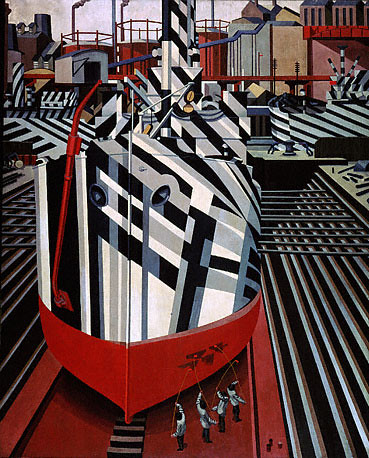
'Dazzle Ship in Drydock' by Edward Wadsworth, 1919:

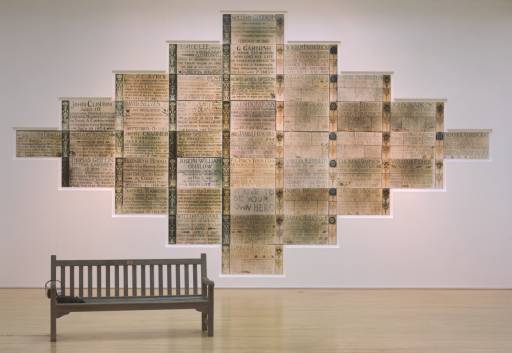
Susan Hiller's (b. 1931) 'Monument 1980-1: Colonial Version', mixed media, was also really interesting and emotive. The work was concerned with the fragmentation of contemporary culture. Hiller seemed to be attempting to return forgotten or lost remnants of history to mainstream attention, which parallels my idea. However she seems to take on an archaeologist role much more than I do. This is revealed in her belief that art should 'reveal, hidden, undisclosed and unarticulated codes within a culture', which is a viewpoint I have a lot of respect for but I do find it rather limited. The work was a massive series of photographs showing plaques that commemorated forgotten hereos of the last century who gave their own lives to save others. I found the work pretty impressive and I felt almost ashamed admitting to myself that had this work not been in a gallery environment, I may have walked on past it.
I was also really impressed with the gallery's bronze and copper & brass sculptures because they managed to look mechanic even when the artist's hand had obviously dented the surface. I like how the artwork combined a rusty metallic, machine-like appearance alongside a human touch.

Descartes' Dualism

I find Descartes extremely interesting. Cognito ergo sum. I think therefore I am. I remember that from school. Caecilius es in horto scribet. The other extent of my Latin knowledge- if only Caecilius is writing in the garden cropped up more often...

My recent work, handmade machine parts from clay, brought Descartes' Dualism theory to my mind. I began creating machine parts in clay, as I did not like the inflexibility of wood and having to try and find metal parts that may suggest a part of a textile machine. However I am finding it impossible to create seemingly hard-edged, machine- casted parts and then it occurred to me... why would I want to? Craft and the hand-made are returning to the forefront of design and the art world, so by producing parts with an obvious individual quality, I am merely commenting on the art industry. The V&A's craft exhibition, Out of the Ordinary, is a perfect example of this Post Modern trend and the rising price of individual designs is also a clear indication.

The making of machine parts has a peculiar paradox to Descartes' Dualism, as his theory suggested that the body works like a machine, that it has the material properties of extension and motion, and that it follows the laws of physics. Therefore by making the body create machine parts, you are constructing another physical form of yourself. The imagination, the mind, is then the nonmaterial entity that controls the body, though according to Descartes the irrational can be controlled by the body, as is the case when someone acts out of passion. Previous to this theory, most accounts of the relationship between mind and body had been uni-directional. I think this theory is really interesting as humans are so fascinated by technical advancements, especially robots. Perhaps we are merely trying to recreate ourselves. This explanation surely fits the work of Stelarc and Orlan...

Developing our Exhibition Proposal for Thursday

Following our seminar with Richard Bell, when he suggested our group wanted to exhibit in the Tate Modern, I sent this email to the John Martin Gallery. The email slightly bends the truth but hopefully they will send us some images of the gallery space and the outside, to show in our presentation for Thursday! This gallery is our ideal; great location in the heart of the West End, one large ground storey, large front windows to attract passers-by, an amazing PR team to design and create promotional material for the exhibition. None of us wanted the Tate Modern, may be in the future you will see our work there, but for now we want intimacy.

To the John Martin employees,

I used to work for Citco, a Hedge Fund Company, along Albemarle Street before changing careers. I am now involved in promoting American art, especially artists who are based in the southern states, and this is where hopefully you can be of some assistance!

Would it be possible for you to send some images of the outside of your gallery space and a few of the inside, as I am proposing to curate an exhibition in London? After visiting your gallery many times during my lunch hour, I now envision the John Martin Gallery when discussing the idea of whether to present in the West End. I would be eternally grateful if you could send a few images of the gallery and its context as it is relatively difficult to communicate a space without visual aids.

Yours Sincerely,

Sarah Baumann

Fingers crossed!!! Lying is bad...

Wednesday, 30 January 2008

Office of Subversive Architecture

Office of Subversive Architecture- All eight of the architects work for OSA on a part-time basis, as they all have other jobs, mainly teaching or working for another architectural agency
- Met each other at university and wanted to realise projects as a team and negotiate the costs and procedures themselves- less weakening of the original concept

'The Accumulator'- Leeds, Feb-March 2008:
- Were given a brief to design the space in the international swimming pool area inbetween when the pool was to be drained and when it was to be knocked down
- OSA liked the idea of giving the public space back to the public one last time- allow the users a chance to say goodbye
- The architects decided to do something abstract as they liked the idea of an empty big basin- chose to design a funnel-like installation, so it appears water would be collected through the ceiling
- Therefore working with the existing structure and character of the space to help transform the area with a minimal effort

'Intact'- Shoreditch, London- 2003:
- When walking through the East End of London- two of the OSA architects stumbled upon a disused signal box, which had had the bottom level taken away to prevent squatters using the premises
- Contacted Network Rail to ask permission- the company was interested but not committed to their suggestions for improvement as the signal box was situated in an area of controversy
- Climbed over before dawn, dressed as council workers (so to not attract attention) and did it anyway
- Before converting a space there are two main questions: what level of sensitivity is needed and shall we try to retain the initial structure?
- Re-painted the signal box, planted geraniums and a little front garden and installed a light, motor battery
- Idea was to draw attention and refurbish a derelict space- create a dream-like image in a decrepid area of London
- Also the OSA has to consider whether to change the public or urban area temporarily or permanently
- This 'subversion' was labelled Guerilla Architecture- though guerilla architecture usually refers to destruction rather than construction

'Hoegarden'- Liverpool Street, London- 2005:
- Used for advertising purposes, though all OSA had to do was incorporate a few logos
- Decided to really contrast the space with its urban surroundings- covered the area with blankets of grass and painted an architectural plan of the area onto the lawn
- Natural idea with a comic side; 'Please Keep On The Grass'
- Also displayed in Manchester between derelict buildings- OSA thought this venue was actually more fitting for the concept

'Launch'- Kassel, Germany- 2007
- 100year old casino- change the space into a lounge temporarily
- The room had a lot of windows so the area was easy to neutralise
- Brought cheap IKEA sofas, projected an video of a sitting cat, Julia, which looped every five minutes
- One half of each drink's table was reflected onto the other side using a variety of lights

'Kunstulle'- Liverpool Biennial- 2006
- Asked to create a new dynamic for the roof of these three art warehouses so it was clear that this was a venue during the Biennial
- To create a beacon and help draw people to this region- revitalise the area- 'Soho-isation'
- Focus on the character and the potential of the space- design was to follow the interesting roofline- minimal intervention as it was a temporary intervention
- Decided to not use doors or windows for the outside roof space- instead the OSA team hung drapes of translucent and red PVC from a metal scaffolding
- Depending on the sky's light- the colour in the room changed- very atmospheric- cosy and intimate.

Friday, 25 January 2008

Inside the White Cube: The Ideology of the Gallery Space

Inside the White Cube: The Ideology of the Gallery Space, by Brian O'Doherty

Indeed tradition itself, as the spacecraft withdraws, looks like another piece of bric-a-brac on the coffee-table- no more than a kinetic assemblage glued together with reproductions, powered by little mythic motors and sporting tiny models of museums. And in its midst, one notices an evenly lighted "cell" that appears crucial to making the thing work: the gallery space.

The history of modernism is intimately framed by that space. Or rather the history of modern art can be correlated with changes in that space and in the way we see it. We have now reached a point where we see not the art but the space first. (A cIiche of the age is to ejaculate over the space on entering a gallery.)An image comes to mind of a white, ideal space that, more than any single picture, may be the archetypal image of 20th-century art. And it clarifies itself through a process of historical inevitability usually attached to the art it contains.

Notes from my reading:
- An evenly lighted cell
- History of Modernism is intimately framed by that space
- History of Modern art- correlated with changes in that space
- Reached a point where we can see the space first before the art
- White, ideal space displaying the archetypal image of twentieth century art
- Ideal gallery subtracts from the artwork all cues that interfere with the fact that it is 'art'
- Work is isolated from anything that would detract from its own evaluation of itself
- Connotations of the white: sanctity of the church/ formality of a courtroom/ the mystique of the experimental laboratory- all joining chic design to create a unique chamber
- The object to be the medium through which these ideas are manifested and proffered for discussion
- Post-Modernism- context becomes content
- Peculiar reversal- object introduced into the gallery 'frames' the gallery
- Modernist- wooden polished floor, painted white walls and evenly light ceiling, as the main light source
- Art is free 'to take its own life'
- Unshadowed, white, clean, artificial
- Works- mounted/ hung/ scattered for study
- Limbolike status- presence of your own body seems superfluous, an intrusion

My group and I seem pretty adamant that we would like to display our work within this Modernist white cube... it begs the question as to why. Amanda's favourite exhibition was an exhibition she saw in Edinburgh showing only craft work. I absolutely loved the V&A's craft exhibition. Perhaps the reason why we are so determined to keep our work within this twentieth century tradition is because mixed media and craft never really had a chance to be displayed in this sanctimonious, fake atmosphere. By forcing our work to be accepted within the art world's most accredited environment may be we will help craft and mixed media gain the recognition it deserves...

Wednesday, 23 January 2008

'Clay Today: Contemporary Ceramists and Their Work'

'Clay Today: Contemporary Ceramists and Their Work':

- Conceptual art exists largely as an idea and largely in the moment
- Clay handled conceptually- not shaped or glazed or fired- against the traditional ceramic vocab
- Exhibitions devoted to unfired clay art
- Conceptual artists have worked with the ephemeral dust or dissolved wet mud
- Much claywork is a 'happening' but even happenings can be- must be- controlled
- The definition of Michelangelo- 'sculpture bisects, or in some way changes, space'

Glazing:
- Glazing adds another dimension of colour and yields a hard, dense, smooth surface that is easy to clean
- Fired glazes run the gamut from clear transparent, translucent or opaque glossy surfaces to stony, dull- surfaced matts- matt glazes tend to stay in one place whilst melting in the kiln
- Poured/ dipped/ brushed/ sponged/ sprayed- each application technique leaves its own mark- brush marks/ pour marks/ sponge marks etc.

Normal consistency:
- Run off fingernails as a long droll
- Some skin should be visible through the glaze coating on your hand
- Even coating of glaze best achieved by pouring and dipping
- Brush in several alternating coats- will blend more evenly
- Spraying= even coat
- Air bubbles can develop
- Metal oxides and stains can be mixed with water and applied by any means under or over unfired glaze resulting in underglaze and overglaze (majolica) decoration

- Clay is an art material that changes- never stays the same until after the final firing- not reveal itself until the final cooling
- Clay sculpture- stable/ mobile/ unfired/ fired
- Adjectives to attain- exciting/ dramatic/powerful
- 3D form- movement/ repetition/ contrast/ variety/ proportion
- Perceptions to communicate- soft/ hard/ light/ heavy/ fragile/ strong
- Might use clay as it does what other materials can not
- Maybe develop a patina- usually associated with wood firing

- Black/ dark brown matt glaze might get the effect I am after...

Subtle Mechanisms by Harvey Blume

'Subtle Mechanisms' by Harvey Blume, Critical Eye, August 13, 1998- An Article on Arthur Ganson

http://www.theatlantic.com/unbound/criticaleye/ce980813.htm

For Arthur Ganson, an artist whose ingenious contraptions tell stories, meaning and motion are all but inseparable.

Arthur Ganson works, as very few artists do, with machines. He builds subtle mechanisms that magnify and reflect on aspects of existence. Given his medium it's at first tempting to think of his work as a throwback to the eighteenth century, with its belief in a clockwork universe activated at the beginning of time by a divine being -- a clockmaker -- then left to run in accordance with the laws of Newtonian mechanics. It was an age with a passion for automatons -- Jacques de Vaucanson's duck, for example, which was rigged to swim, swallow, and produce excrement. According to one contemporary account, this duck "performed all the quick motions of the head and throat which are peculiar to the living animal, and ... also the sound of quacking." In the eighteenth century, quacking and crapping mechanical ducks were in philosophical earnest, intended, as the French philosopher Jean Baudrillard put it in Simulations (1983), to be the "analogy of man and ... his interlocutor." Ducks and other automatons pushed the clockwork metaphor to its limit, embodying viewers' questions about the real difference, if any, between mechanism and organism. Might the latter be merely a highly refined version of the former? Were living things God's finest clocks, built for swallowing, defecating, and, in the case of humans, talking, too?

Previously in Critical Eye:"Truth and Consequences" (May 1998)The films of Luis Buñuel, argues Lee Siegel, reveal a vision of human violence that is complicated, unsentimental, and always honest."Posing for Egon Schiele" (February 1998)Lee Siegel on the artist, the critics, and the importance of being jaded.Discuss this column in the Arts & Literature forum of Post & Riposte.

Ganson's work isn't ruled by a clockwork philosophy; it is open to whatever truths about life and motion his wires, motors, oil, and chains will lend themselves to. His pieces are not, like de Vaucanson's duck, scrupulous mechanical copies of living things, but are instead suggestive -- or, as Ganson puts it, "gestural," frequently grounded in biological and bodily processes but never limited to them. And Ganson proves just as resistant to today's dominant metaphor machine, the computer, as he is indifferent to the Newtonian metaphor of the clock. This summer represented Ganson's breakthrough into the New York art world; an exhibit of his work, on view from May 30 to July 18 at the Ricco/Maresca Gallery, was praised by The New Yorker as including "miraculous whirligig sculptures." I met up with the forty-three-year-old artist at the MIT Museum in Cambridge, where his work remains on display, and where I first encountered it. The MIT Museum specializes in exhibits about science and its history -- as in a current installation on the history of the slide rule -- and devotes a room to MIT students' most memorable hacks. (How did they get that car to the roof the administration building overnight, anyway?) To go from such displays into a gallery of Ganson's work is to experience a sudden shift from documentation, however informative or amusing, to the more complex claims and rewards of art.

Cory's ChairIn "Cory's Chair," a small yellow plastic chair is torn apart by four mechanical arms, which then reverse the motion and reassemble it. The violent action of the mechanism reminded me of a spider's mouth fastening on prey. Ganson's initial thought, though, pertained to time. "The exploding chair is like the current moment," he told me. "It's around long enough for you to see what it is, and suddenly it's gone." The idea of the exploding moment led Ganson to considerations of the Big Bang, which joins the Big Contraction among the multiple meanings arising from this piece. For Ganson it's crucial that it be a chair endlessly torn apart and put back together rather than, say, an anonymous car part or lawn-mower gizmo. An exploding gizmo might say something about factory work and the assembly line, but an exploding chair sets off a broader range of feelings, according to Ganson. "It's a well-understood object in a strange situation. We fill in the blanks. Why is it doing that?" "Cory's Chair" points both to the instant and eternity, and Ganson toys with the dimension of time in many of his works, which often repeat themselves at fixed intervals -- though in the case of "Machine with Concrete" you'll just have to take the artist's word for it: the sculpture features fast gears acting on a system of slower gears that will drive a steel bit into a waiting concrete slab some 2.191 trillion years from now. (One has to assume this machine has never been adequately tested.) Ganson's time play is usually on a more human scale, and surrounds his work with an implicit music, a sense of dance. The dance is made explicit in a piece like "Machine with African Porcupine Quills," whose arms do a high-speed flamenco with sword-like objects. The mobile nature of Ganson's work appeals to children, who are not yet inculcated with the belief that art and motion can't be combined. Ganson is one of the few contemporary artists whose work charms almost immediately rather than luring viewers into a series of staring contests with ominous objects. And some of the pieces are interactive, driven by human beings rather than electricity. "Brownian Motion," when pulled along, communicates the motion of its wheels to a tray of rice pellets that swarm over themselves like larvae, or, from a distance, appear to undulate like a single wave-like living thing.

Ganson's accessibility does not come at the expense of complexity or depth. "Requiem for a Lost Uncle" consists of twenty-three small scraps of paper positioned at the end of rods that lift and fold them so that they appear to be birds flying off in a serene token of a soul's release. "Machine with Ball Chain" evokes an opposite sense: of weight, density, gravity, effort -- of forced labor, perhaps, or peristalsis (enter the bowels of de Vaucanson's duck). As the chain is tugged slowly down through an opening, it defies Ganson's usual repetitive motions, huddling into different patterns of resistance every time. Ganson's work can be compared to that of Rebecca Horn, the German artist who also employs motion but who buries her apparatus in feathers and cloth and subsumes it in symbolism pertaining to sex or violence and, in many cases, both. Ganson's works are lighter and more forthcoming about their own composition; the mechanism is always a good part of the message. When I alluded to the fragility and delicacy of some of his wire constructs, he responded, "Those are all human qualities. Fragility, sadness, joy, fear, and also wonderment -- those are the feelings that caused me to make them in the first place." Ganson has been fascinated with motion since devoting his sixth-grade doodles to studies of a race car ramming into a rock. When I asked why he hasn't used computers to carry out simulations of the motions and collisions that intrigue him, he said, "In the digital realm, you can do anything, draw anything. You don't have to obey the laws of physics. So when you see something digital, it's less surprising than when you see a physical object doing it; there's less mystery." Ganson isn't ready to abandon atoms for the easy malleability of bits. "Part of the reason for me spending my time, my limited time on earth, in this pursuit," he says, "is to work with the physical world and see what I can say with it."

Given Ganson's respect for the expressive possibilities of matter in motion, one piece in particular seemed to serve as his self-portrait. In "Child Watching Ball," a doll's face swivels in perfect accord with a ball's gyrations. No matter how fast the ball moves -- the speed is determined by how fast you turn a handle -- the doll's eyes refuse to break contact, as though permanently hypnotized. Ganson disagreed with me that "Child Watching Ball" says any more about him than his other pieces; he regards them all as telling part of his story. Not surprisingly, Ganson did warm to a statement the novelist Umberto Eco made about his own work -- namely that its focus was "to transform machines into narrative, to show how much narrative power they have inside them, how they can tell stories." For Ganson, as for Eco, motion and meaning are close to inseparable.Ganson's work is at home in a place like the MIT Museum because his small machines are so exquisitely engineered, and in a New York gallery because they are created to accomplish nothing else than art. For Ganson, the clockwork universe, with its strictly mimetic mechanical forms, has long since run down, and the digital universe, the world of virtual reality, where anything goes, has not yet been booted up. It's in that space -- where objects have real weight, real motion, and real implications -- that Ganson as an artist thrives.